
2026-09-21
Super bubbles (referred to as microbubbles) are huge hollow structures formed by the release of massive energy from the activity of massive stars. A team of Chinese and foreign scientists discovered 118 microbubbles in the Andromeda galaxy, and through observation and analysis, confirmed the energy source of galaxy turbulence. This achievement was published online on September 17th in the international academic journal Nature Astronomy.
Galactic turbulence is a common random motion of cosmic gas, which affects the aggregation and formation of stars under the influence of gravity, and thus participates in regulating the evolution of galaxies. For a long time, due to technological limitations, research on the energy sources of galaxy turbulence has mainly relied on indirect estimation and judgment.
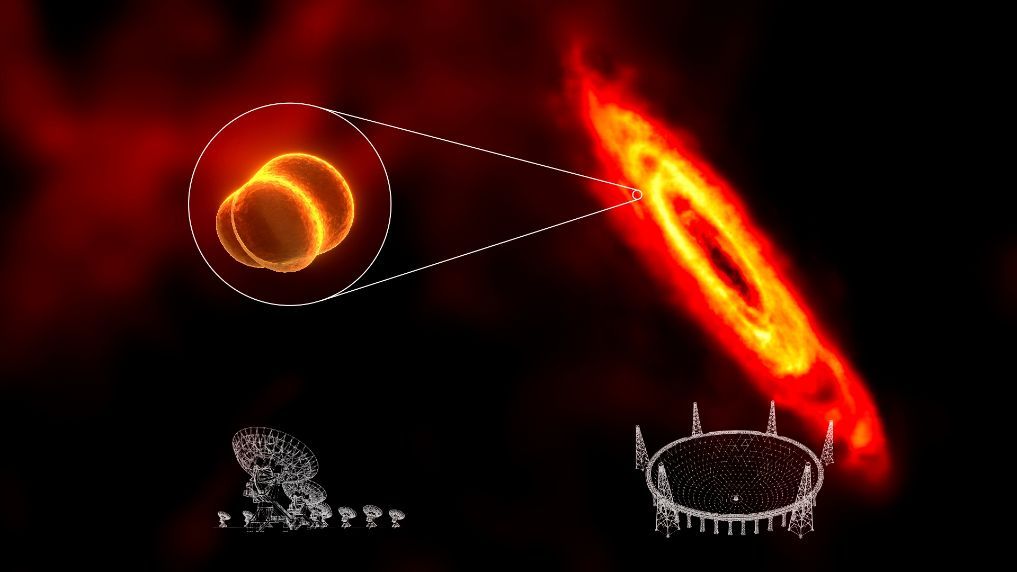 The picture shows a schematic diagram of the super bubble in the Andromeda galaxy. (Image provided by Tsinghua University)
The research team led by Professor Li Di, the director of the Department of Astronomy of Tsinghua University and the former chief scientist of China's Celestial Eye (FAST), joined hands with the National Astronomical Observatory of the Chinese Academy of Sciences and many partners at home and abroad, and finally found 118 superbubbles in the Andromeda galaxy, which is about 2.5 million light-years away from the Earth, through the joint observation of FAST and the U.S. Carl Jansky Very Large Array Telescope (JVLA).
Li Shu introduced that supernova explosions during the death of massive stars can generate microbubbles in interstellar gas. These 118 supernovae correspond to nearly 10000 supernova explosions over the past 40 million years. The team estimated the average kinetic energy input rate of microbubbles and the dissipation rate of turbulence through actual observations, and ultimately confirmed that continuous supernova explosions in star clusters are the energy source of galaxy turbulence.
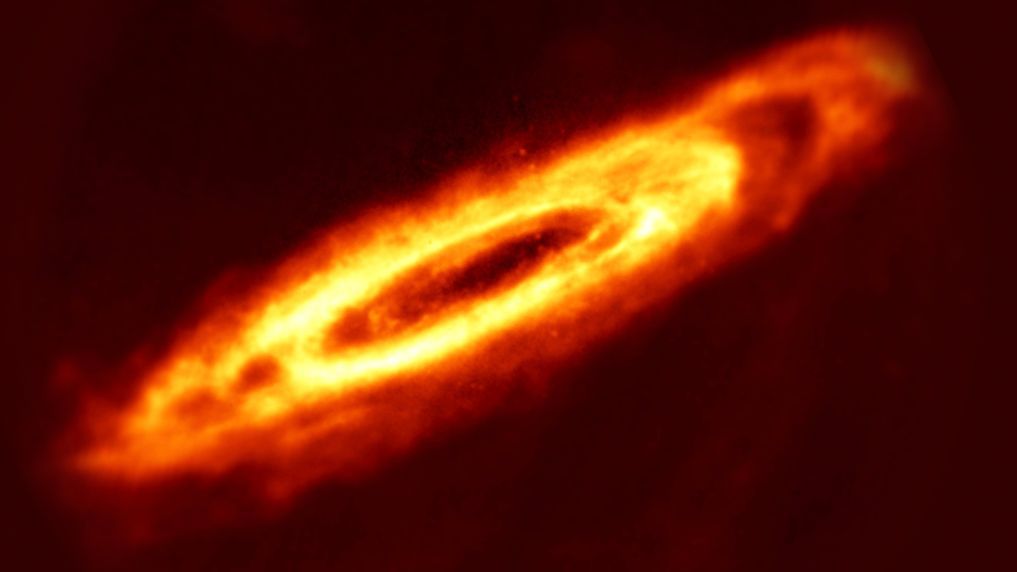 The picture shows the actual measurement of gas in the Andromeda galaxy. (Image provided by Tsinghua University)
Superbubbles are an important reference for studying galaxy evolution, "said Meng Fanyi, the first author of the paper and a postdoctoral fellow in the Department of Astronomy at Tsinghua University. Thanks to FAST's highly sensitive measurement of large-scale dispersed gases and JVLA's detailed resolution of interstellar gases, it is possible to achieve an" accurate portrait "of microbubbles and explore the challenges of turbulent energy injection and transfer spanning millions of years.
The evolution of celestial bodies is closely related to the evolution of the Earth. "Li Shu believes that in-depth research on the impact of supernova explosions in neighboring galaxies on galaxy gas provides important basis for understanding the evolution of galaxy morphology and related physical processes, and will also help humans gain a deeper understanding of their own galactic home on a large scale. (Outlook New Era)
Special statement: if the pictures and texts reproduced or quoted on this site infringe your legitimate rights and interests, please contact this site, and this site will correct and delete them in time. For copyright issues and website cooperation, please contact through outlook new era email:lwxsd@liaowanghn.com
 Recommended Reading Change it







Submission mailbox:lwxsd@liaowanghn.com Tel:020-817896455
粤ICP备19140089号-4 Copyright © 2019 by www.outlooknewera.com.cn all rights reserved
>


